
United Can't Control Games
Why a team so dangerous on the counter struggles when the opposition gives it the ball.
Sections
Introduction
We get the ball into the opposition’s half. The first route forward is blocked. A couple of players come short, others wait for something to happen, and eventually the ball reaches Bruno Fernandes.
He tries a difficult pass. An early cross. Something that might turn an attack going nowhere into a chance.
Sometimes it works because Bruno is that good.
Often, we lose the ball without having made the opposition do much defending.
That is what bothers me. Losing possession is part of football. But United give it away too easily, before we have moved the opposition around, opened up space or got enough players into positions from which they can help.
Then we fail to keep the opponent under pressure. They get out, move up the pitch and start their own attack. We turn around and chase.
A few minutes later, we do it again.
United can be dangerous when a game opens up. We are much less convincing when we have to decide how it should be played. That shows against a deep defence, when protecting a lead and when an opponent starts getting on top.
Those situations all require control. And control involves far more than having the ball.
The opposition don’t have to play our game
In The United Cycle, I looked at why United’s counter-attacking strengths do not give us a reliable way to dominate games. Carrick’s possession record showed the gap.
By 16 September 2026, United had averaged 2.6 points per game under Carrick with less than 50% possession, against 1.5 with more than half the ball.
The score and opposition affect possession, so these numbers need context. But they fit a familiar problem: we are better at exploiting space than creating it.
Under Solskjaer in December 2019, nine of our first 23 league goals had come from transitions. We had won four and drawn one of the first five matches in which we had less than half the ball. The strength is familiar.
Give Fernandes runners against a retreating defence and he can take several opponents out of the game with one pass. Give Mbeumo space to attack and defenders have to turn towards their own goal. Give Cunha room to carry and he can force somebody to leave their position.
Those are real strengths. United should use them.
The opposition know that too.
They can sit deeper, protect the centre and leave less space behind. They can make United bring the ball forward and ask a different set of questions. Can we move a compact defence? Can we create a good chance when the first pass is unavailable? Can we keep attacking without forcing the move?
The September derby gives us an example. City went down to ten men and sat deeper. United had more responsibility to create, but less space to attack. The extra player did not automatically give us a better attack.
That is a problem if we want to win the league. Opponents have little reason to give a superior team an open game if sitting deeper makes it less dangerous.
We keep confusing speed with progress
I want United to attack quickly when an opportunity is there. If we win the ball and the opposition are scattered, we should take advantage.
But playing forward quickly has become too close to an objective in itself.
Sometimes the pass goes forward, but the attack gets worse.
The receiver has his back to goal and two opponents around him. Nobody is close enough for a combination. The runner is not ready. The space Bruno is trying to find has not actually opened.
When that happens repeatedly, “we play attacking football” becomes a fairly generous description of giving possession away.
Against an organised defence, some work usually has to happen before the decisive pass. Somebody has to move an opponent. A midfielder follows a player coming short. A full-back narrows. A centre-back steps towards the ball and leaves space behind.
Somebody then has to use the space that opens.
If Cunha comes short, who goes beyond him? If Mbeumo moves inside, who holds the width? If Mainoo receives in a pocket, does he have a teammate nearby and another threatening the next line?
Against Ipswich, Cunha and Bruno both came towards the ball. Too few players stayed ahead of it to threaten the defence.
So we push the attack anyway.
There is another option: keep the ball, change the angle and make the opposition defend again.
Recycling the ball only helps if players move while it travels. Change the angle, make a defender decide whether to follow, and attack the space he leaves.
We don’t do enough of that.
Carrick used short combinations at Middlesbrough to draw opponents forward and play through them. At United, too many moves stall after the first line is beaten.
If they refuse the invitation, we still need another way forward.
A quick attack can be the reward for patient preparation. We too often skip the preparation and hope the quick part works.
What can these players actually do with the ball?
Some of our defenders are too limited on the ball for the football we want to play.
Martínez can pass through midfield. Heaven can carry past the first opponent, and his willingness to play brave passes forward has surprised me. Give him more trust and minutes, and I think there is more to come.
We need more of that across the back line. When a defender carries past a pressing player, somebody else has to leave his position to stop him. A pass through midfield can take several opponents out of the move. Both create space for the players ahead.
Maguire can play forward passes too. But we do not consistently force opponents to break their shape. Too often, they can let our defenders have the ball, block the routes into midfield and wait for us to force something.
Having the ball at the back is easy if the opposition are happy for us to keep it there. The quality we need is the ability to get past them.
Who actually controls our midfield?
We have spent years trying to get the balance right in midfield. We still need someone to slow an attack down when the quick ball is wrong.
This problem started long before Carrick became the manager.
Pogba could pass and carry from deep, but he needed somebody behind him. Matić gave him cover and helped move the ball forward. Having a talented midfielder was never the same as having a balanced midfield.
Matić did bring control. He could hold his position, protect the ball and find the next pass. The problem is that we have not made those qualities a dependable part of how the team plays.
Carrick is still my reference for the role. He made the next decision easier for everyone else. He knew when to play through a line, when to switch the ball and when to keep it simple. We have missed that reliability.
Tielemans can break lines with his passing. Santos can play through pressure. There is quality in this midfield. My frustration is that it still does not add up to reliable control.
Mainoo can escape pressure. Baleba can carry us forward. But we still need someone to decide when to accelerate, when to switch play and when to keep the ball.
My argument is that United might be a better team with a controlling six setting the tempo, rather than asking Bruno to do it. Bruno wants to make something happen now. We need someone who recognises when the attack needs another pass, a switch of play or a moment to let the team move up together.
His job is often the pass before the chance. Find the player between the lines, switch the attack or turn down a forward ball that is not on. Let him set the tempo and let Bruno take more risks near goal.
A controlling midfielder needs teammates giving him options. Otherwise, even the patient player is left choosing between a forced pass and going backwards.
Why our attacks run out of options
We have good attackers, but too many of them offer similar things. Amad can combine in tight spaces and Cunha can carry through traffic. We still lack enough players who can repeatedly beat a set defender and force the rest of the defence to react.
At his best, Rashford was dangerous running behind. That does not make him an elite dribbler against a defence already in position. Mbeumo gives us movement, combinations and finishing. I would rather use those strengths than leave him wide and expect him to keep beating a full-back on his own.
That matters against a low block. Switching the ball to an isolated winger achieves little if he cannot take advantage of the one-against-one.
If he cannot get past his opponent consistently, the defending team may not need to send another player across. It can keep protecting the middle and accept a cross from outside.
The full-back can change that picture. An overlap gives the defender another runner to deal with. A player moving inside can provide a short combination or pull someone out of position.
But the movement has to offer a real threat.
Dalot, Shaw and Mazraoui can contribute with the ball. But if the plan leaves them wide and asks them to beat a defender, we are asking for a strength that none of them offers consistently enough. We need to give them combinations and runners, or put a different kind of player there.
Cunha wants to receive between the lines and carry. That often brings him into the same areas as Bruno. If both come towards the ball, who is stretching the defence?
If Cunha and Bruno both come short, somebody else has to run beyond them. Otherwise, we bring more players towards the ball without making the defence move.

A simplified example: Šeško draws the centre-back out and Mbeumo attacks the gap, with Mainoo supplying the pass.
Basic stuff. But too often, even these simple movements are missing from our attacks.
There were periods under Amorim when those connections looked clearer to me: shorter diagonal passes, players exchanging positions and somebody available on the far side. That is the part worth keeping. The same players can give each other better options when their roles fit together.
The formation alone tells us very little. Two teams can both attack in a 3–2–5 and give the player on the ball completely different options.
When we run out of ideas, find Bruno
Fernandes gives us an exceptional way out. He finished 2025/26 with 21 league assists and 136 chances created. The question is what we do when he cannot find the answer.
He can turn a poor attack into a chance. He sees passes other players don’t see and can execute things most wouldn’t attempt.
In the first article, I called this the Bruno paradox: his brilliance can hide how much the team depends on it.
A brilliant pass can rescue a poor attack. The problem is how often we need one. We get the chance and overlook how little the team did to create it.
Bruno takes risks. Near the box, that can create a chance. In midfield, forcing the same pass can expose a team still moving forward.
I don’t want to coach the creativity out of Fernandes. I want United to stop needing that creativity to solve every stage of the attack.
Build useful connections around him. Give him movements that suit his passing. Make sure other players can progress the ball and create an opening without first finding him.
The team still has to function when Bruno is marked out, injured or having a bad day. His creativity should improve our attack, not hold the whole thing together.
We shoot. A lot. But from where?
Opta’s 8 October analysis puts United on 113 shots and 9.1 non-penalty xG across the opening five Premier League games of 2026/27: first and fourth in the league respectively.
That sounds quite good. Then you look at the shots themselves.
In that same sample, Opta reports 0.08 non-penalty xG per shot, joint-second lowest, and a 17.9-metre average shooting distance, second furthest from goal.
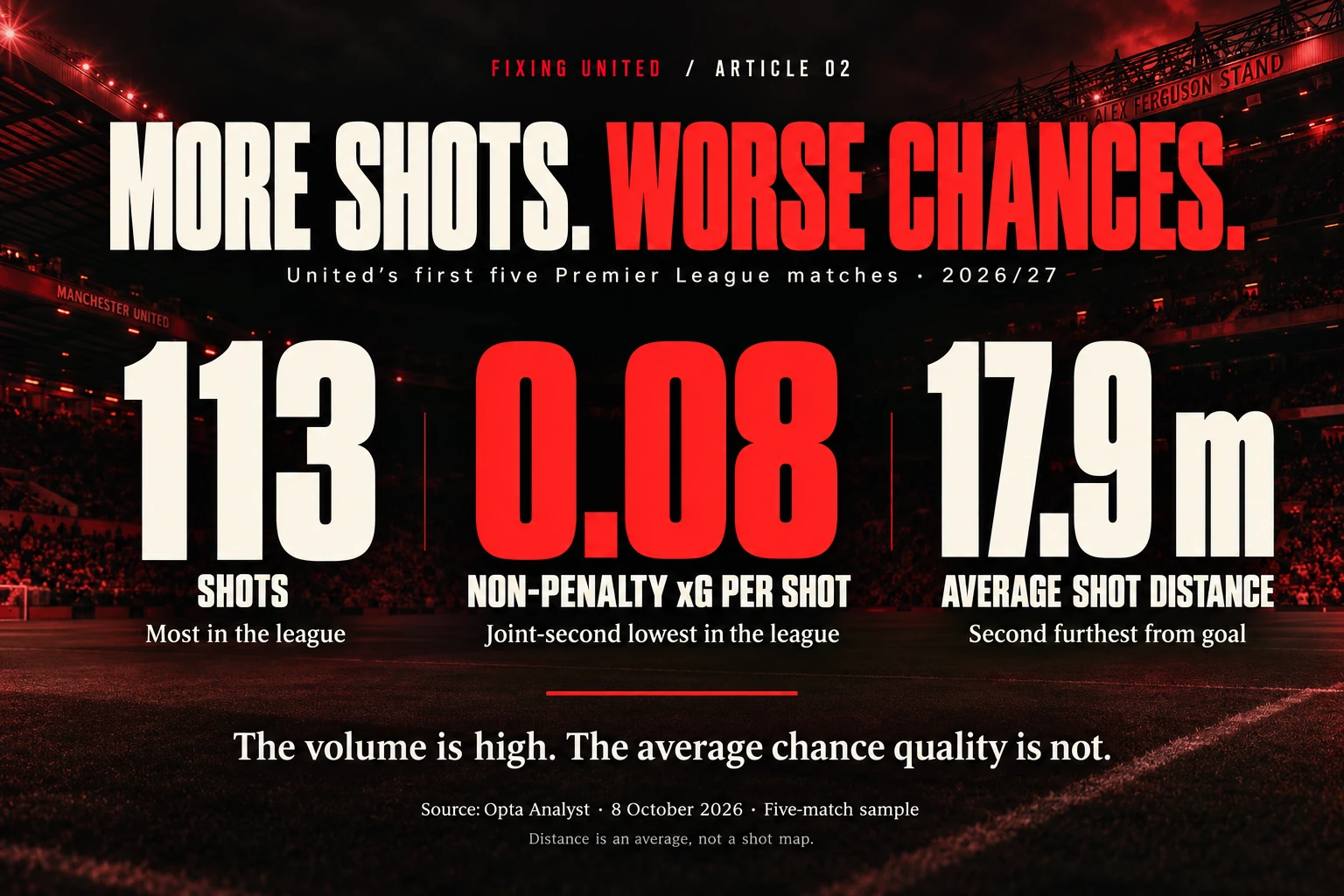
That is dreadful. We’re shooting more than anyone else, but the average quality is near the bottom of the league. And we’re doing it from further out than almost everyone else.
We also had a league-high 182 touches in the opposition’s box. We get there. The problem is how often we settle for a poor shot instead of building a better chance.
Too often, we shoot because the move has run out of ideas. No combination, no run, so somebody has a go. The shot count rises. The chance quality stays poor.
There is nothing wrong with taking a good opportunity from distance. But I don’t want shooting from there to become our answer to failing to get closer.
I want us to move defenders, combine around the box and work for something better.
These figures cover the first five league matches, not the whole season.
Source: Opta Analyst, 8 October 2026
The coaching question is what comes before the shot.
If we want players to turn down a poor attempt, we have to give them a better continuation. A teammate to combine with. A run that moves a defender. An option to recycle and attack again.
That is why the movement, the one-against-ones and the shot selection belong in the same argument. If we cannot move a defender or beat him, the move runs out of options. Bruno tries something difficult, or somebody shoots. We need a better way to keep the attack going.
Why does one failed attack end the pressure?
This is one of the biggest differences between having possession and controlling a game.
Where we stand before losing the ball decides how quickly we can challenge for it again. Short passing distances also put teammates close enough to help when the move breaks down.
The nearest players close the ball. Others block the first passes out. The midfield moves up behind them. The defensive line collects the clearance or challenges the forward trying to hold it.
The first attack fails, but the opponent still cannot get out. We collect the clearance and attack again before their team can move up.
United too often allow a failed attack to end the whole spell.
The pass is cut out and the receiver has time. Somebody starts chasing, but the next option remains open. The defence has not moved high enough to collect the next ball, or cannot step forward safely because the player in possession is not under pressure.
The opposition escape.

A deliberately simplified example with our first-choice XI. The same risky pass is intercepted, but the support changes what follows: a free receiver turns inside on the left; on the right, pressure forces a clearance, Martínez challenges and Mainoo collects the second ball.
Opta’s October examples against City and Fulham show opponents finding ways past United’s pressure. We leave them a way out, and they use it.
Watch what happens after our next attack breaks down. Do we force another clearance and win the ball back, or can the opponent find a midfielder, turn and play? Do we move up together, or start running back? Too often, I see us giving the opposition time to breathe and a chance to take over.
Our attacking positions are part of the problem. If we force the ball before the team has moved up together, we are badly placed to win it back. If the support is too far away, the nearest player cannot turn a challenge into a collective response.
The defensive line matters too. Collecting clearances and defending forward require anticipation, mobility and confidence in the space behind. Those qualities affect how small the team can keep the pitch.
A higher line needs pressure on the passer. Give him time to look up and we leave space behind for him to use.
The pressure on the ball and the support behind it have to work together.
That is why I don’t see this as a separate attacking issue followed by a separate defensive issue. The way we attack helps decide what happens when that attack fails.
Running at someone is only the first action
Fernandes makes the lack of connection particularly visible when United press.
Him starting the pressure is not automatically wrong. We need players willing to act. But there has to be a shared understanding of when to go and what everyone else does.
Who closes the next receiver? Which pass are we trying to force? Does midfield move forward? Can the defenders follow?
Opta’s account of the 13th-minute sequence against Como describes Fernandes closing Jacobo Ramón without enough pressure on the nearby options. Como played out and Bruno gestured towards his teammates.
Either Bruno goes too early or the others react too late. The result is the same: Como play around the first challenge.
United recorded 443 high-intensity pressures against Como. There was activity. Too little of it stopped Como playing through us.
Source: Opta’s analysis of Fernandes’ pressing against Como
An organised press against a team building from the back is different from reacting immediately after losing possession. But both require players to recognise the same situation and support the first action.
United don’t do that reliably enough.
Carrick has to make those actions work together. The players have to carry them out.
Being ahead should make the game easier to manage
Carrick’s spring results were strong: United won 12 of the 13 league games in which we led, dropping only two points. But recovering a lead is different from keeping control.
Against Fulham on 1 February 2026, Casemiro went off after 75 minutes with United 2–0 up. Fulham took over and reached 2–2 before Šeško’s late winner.
Against Liverpool on 3 May, another 2–0 lead became 2–2 before Mainoo won it. Both games ended with three points. Both also required us to find another goal after giving away a two-goal lead.
Keep showing for the ball. Make them chase. If the third goal is there, take it. If it isn’t, keep possession and build again. Urgency in the movement does not require impatience on the ball.
Raise the floor
I’m less interested in how good United can look for twenty minutes than in how badly the football can fall apart when the first idea stops working.
We know the ceiling can be high. Bruno finds a pass, the forwards have space and suddenly we look capable of scoring against anyone.
What happens when those conditions disappear?
The problems in this article feed each other. A rushed pass reaches a teammate without support. A move without a next option ends in a poor shot or a forced ball. The team is too spread out to win possession back, and the opposition get the spell we should have denied them.
That is the floor we need to raise.
In The United Cycle, I argued that United’s players, recruitment and coaching have to serve the same idea. This is what that means on the pitch: players who can keep the ball, a team that supports the attack and a response that keeps the opponent under pressure.
Over a long season, “give it to Bruno and hope” is not enough.
Help us Fix United
The discussion does not end here. Share this article with someone who cares about where United go next.
@FixingUnited on InstagramWhat did you think?
Mikko Seppä is a football coach and analyst writing independently about Manchester United. Methodology →
- 01Read now
The United Cycle
- 02Read now
United Can't Control Games
- 03This week
The Defence Is Holding United Back
- 04Soon
The Bruno Paradox
- 05Soon
Where Did All the Money Go?
- 06Soon
So How Do We Actually Fix United?
Discussion
0 comments- Loading discussion…