
The United Cycle
Manchester United keep changing managers. The problems stay remarkably familiar. Maybe it's time to ask why.
Sections
There is a cycle every Manchester United supporter has become painfully familiar with.
- Hire a new manager.
- Enjoy the new-manager bounce.
- Underinvest in what the squad actually needs.
- Watch results decline.
- Sack the manager.
- Repeat.
We reached step five in January, when Ruben Amorim was dismissed after just 14 months in charge. Michael Carrick arrived, United started winning, and by the end of May they had somehow finished third in the Premier League. Bruno Fernandes had broken the league's single-season assist record, Champions League football was back at Old Trafford, and there was a genuine sense that things might finally be moving in the right direction.
That was five months ago.
On Wednesday night, United lost 4-1 to Como, a club playing its first Champions League campaign. It was United's seventh consecutive match without a victory, and the performance was every bit as concerning as the result. Nico Paz scored after two minutes, Como repeatedly found space between United's players, and by the time Joshua Zirkzee scored a consolation goal in stoppage time, much of the travelling support had already seen enough.
The aftermath was almost as revealing as the match itself. Fernandes questioned the decision not to press Como more aggressively, while Carrick criticised his team's lack of intensity and willingness to work. The captain appeared frustrated with the tactical approach, the manager with the players' application. Neither sounded particularly convinced by what had happened on the pitch.
Sky Sports' report on the match and its aftermath captured the disagreement. It also raised a rather uncomfortable question: how can a team that finished third just a few months ago look so unsure of what it is supposed to be doing?
Naturally, the conversation has already turned to Carrick's future.
And perhaps it should. A Manchester United manager cannot oversee performances like these without facing serious questions. Carrick is responsible for the team's preparation, tactical approach and performances. The players are responsible for carrying out their jobs, too.
But after more than a decade of watching different managers struggle with remarkably similar problems, I find it increasingly difficult to believe that the manager is the only explanation.
United have tried possession football, counter-attacking football, aggressive pressing, different defensive structures and several versions of what was supposed to be a long-term rebuild. The managers have changed, the formations have changed and hundreds of millions of pounds have been spent on new players. Yet the same weaknesses keep appearing.
We struggle to control matches, particularly when the opposition is happy to let us have the ball. We rely too heavily on individual brilliance to create chances. Our midfield gets stretched, our defensive line struggles to support an aggressive press, and players who look excellent in certain situations suddenly look uncomfortable when asked to play a different way.
The details change from manager to manager, but the pattern is difficult to ignore.
I don't think United's biggest problem is that we keep hiring the wrong people. It's that we haven't consistently built the right football team for the way we want to play.
And until we understand that distinction, I'm not sure the next managerial appointment will solve very much.
An identity that only works in certain games
One of the most common complaints about Manchester United is that the club has no football identity. I understand the frustration, but I don't completely agree.
For much of the post-Ferguson era, United have actually had a fairly recognisable identity. We can be extremely dangerous when there is space to attack, particularly against opponents who commit players forward and leave themselves exposed in transition.
Give Bruno Fernandes time to look up with runners ahead of him and he can produce a pass that takes half the opposition team out of the game. Put Bryan Mbeumo or another quick forward into space against a retreating defence, and United suddenly look capable of hurting almost anyone.
We've seen this under several managers. Some of United's best performances in recent years have come against stronger opponents, when the team has been able to defend compactly and attack quickly.
The problem is that not every opponent is going to play along.
When United face a well-organised defensive block, the picture often changes dramatically. There is less space behind the defence, the opposition midfield stays compact, and suddenly the players who looked so dangerous in transition have to create openings through coordinated movement and precise combinations.
That's where United frequently run out of ideas.
The ball moves from side to side without much purpose. Players come short to receive rather than threatening the space behind the defence. Bruno drops deeper to get involved, which sometimes leaves fewer players in dangerous attacking positions. Eventually, someone attempts a difficult pass, an ambitious cross or a shot from distance.
Sometimes it works, because United have players capable of producing something exceptional. But the best teams don't depend on exceptional moments to create ordinary scoring opportunities.
They have repeatable ways of creating advantages.
Carrick's results last season offered an interesting illustration of United's strengths and limitations. BBC Sport's September tactical analysis found that United had averaged 2.6 points per game when they had less than 50% possession under Carrick, compared with 1.5 points when they had more than half the ball.
That's a substantial difference, although it doesn't prove that possession itself was the problem. Strong opponents often have more of the ball, and teams protecting a lead may deliberately surrender possession. The score, opposition and match circumstances all affect those numbers.
Still, the pattern fits what we have been watching. United are often more comfortable exploiting space than creating it.
And that's a serious limitation for a club that wants to compete for the Premier League title.
A title-winning team needs more than one way to hurt opponents. It has to survive periods without the ball, punish teams that press high and find solutions against opponents who defend deep. It needs to control the rhythm of matches rather than constantly allowing the opposition to dictate the conditions.
United have been able to do some of those things, in some matches, under some managers. What they haven't managed is to make them part of a reliable, collective way of playing.
Which brings us to Carrick.
His first few months were genuinely impressive, but they may also have told us something misleading about the state of the team.
What Carrick inherited, and what he changed
When Carrick replaced Amorim in January, he made several sensible adjustments. He simplified the defensive structure, brought more balance to the midfield and put important attacking players in positions where they could be effective.
United became more compact and harder to play through. They were dangerous on the counterattack, and their attacking players benefited from having clearer roles. Carrick won 12 of his 17 Premier League matches, a remarkable return that helped take the club to third place.
He deserves considerable credit for that.
But the results were not quite as convincing as they appeared.
In May, BBC Sport examined the underlying numbers behind Carrick's success. United had been exceptionally clinical in front of goal, scoring seven more goals than the quality of their chances would normally suggest. Eight Premier League teams had generated a higher expected-goals total during the same period.
Expected goals are not a perfect measure of attacking quality, and outperforming them is not automatically evidence of luck. Good finishers can consistently convert difficult chances, and a manager deserves credit for putting his best attackers in situations where they can score.
But the numbers suggested that United's results were stronger than their chance creation. That's an important distinction, particularly when deciding whether a successful run of matches represents a sustainable improvement.
Carrick had found an effective way to get results from the players available to him. That wasn't necessarily the same as building a team capable of dominating matches over an entire season.
There is also another part of the story that I think deserves more attention: the work Amorim had already done.
I wasn't convinced that Amorim's 3-4-3 was the long-term answer for United. He could be too rigid, the attacking football often lacked variety, and his overall results were nowhere near good enough. According to the Premier League's review of his departure, he won just 32% of his league matches, and United finished 15th in his only full season.
Those numbers are difficult to defend.
But they don't tell the whole story either.
When Amorim was dismissed in January, United were sixth, only three points behind fourth place. The timing also matters. Mbeumo and Amad had been away at the Africa Cup of Nations, while Fernandes had been injured. Losing three important attacking players simultaneously would have been difficult for any manager, particularly one still trying to establish a demanding tactical system.
There was also something I felt had improved under Amorim, even when the results were poor. From his earliest training sessions, there appeared to be a greater emphasis on collective defensive effort. Players were expected to recover their positions, track runners and contribute without the ball.
That doesn't mean the pressing always worked. There were obvious structural problems, and the system could leave United exposed. But I felt the willingness to work for the team had improved.
It's worth asking whether Carrick benefited from some of that foundation.
He inherited players who had spent more than a year working within a demanding defensive structure. He simplified their responsibilities, made the team more compact and benefited from the return of key attacking players. That combination may help explain why the improvement was so immediate.
This isn't an attempt to take credit away from Carrick or hand it all to Amorim. We would need much more detailed physical and tactical data to establish how much of Carrick's success was inherited.
But it is a legitimate question, and one that becomes even more interesting when we look at what has happened since the summer.
Carrick appears to have tried to make United a more possession-oriented team. That ambition makes sense. If United want to challenge for the title, they need to be capable of controlling matches rather than relying almost entirely on transitions.
The difficulty is that wanting more control and having a squad capable of providing it are two very different things.
According to Opta's October analysis, United's average Premier League possession rose from 49.1% under Carrick last season to 59.9% at the beginning of this campaign. That's a significant change, even allowing for the small sample and the influence of individual matches.
The team has been spending considerably more time with the ball, but that hasn't translated into consistently better attacking football. And without possession, United have looked increasingly vulnerable.
The same analysis found that United were operating in a high defensive block 42% of the time, the highest proportion in the Premier League at that point. Yet their pressing effectiveness was far less impressive. They allowed opponents an average of 12.1 passes per defensive action, only marginally better than the league average of 12.5, and ranked 15th for high turnovers.
In other words, United were trying to defend high up the pitch more often without consistently winning the ball there.
The explanation may lie in the distance between the players doing the pressing and the defenders supposed to support them.
An aggressive press requires the whole team to move together. If the forwards push high but the defensive line remains too deep, the midfield is left covering an enormous amount of space. Once the opposition plays through the first line of pressure, it can attack a midfield that is retreating and a defence that is already worried about the space behind it.
This is where the qualities of individual players start to matter.
Harry Maguire is a very capable defender in the right circumstances. He's strong in the air, reads danger well around his own penalty area and is a better passer than he sometimes gets credit for. But he isn't particularly quick across the ground, which becomes a problem when the team wants to defend large spaces behind a high line.
Lisandro Martínez offers different strengths. He's brave in possession, aggressive in duels and excellent at finding progressive passes through the opposition's midfield. But his lack of height creates certain aerial challenges, and injuries have made it difficult for United to build a consistently available defensive partnership around him.
Neither player is a bad footballer. That's not the point.
The question is whether the defenders United have are collectively suited to the football the team is being asked to play.
The same applies to the full-backs. Luke Shaw remains technically capable and tactically intelligent, but he isn't a long-term solution around which to build the next version of United. Diogo Dalot offers athleticism and versatility, although I struggle to identify a particular part of his game that gives United a consistent elite-level advantage. Noussair Mazraoui brings different technical qualities, but the broader question remains: do United get enough from their full-back positions to support a possession-dominant team?
The emergence of Leny Yoro and Ayden Heaven offers encouragement. Both have qualities that could become extremely valuable in a more aggressive defensive structure, particularly Yoro's pace and Heaven's confidence in possession. But young defenders need a clear collective system around them. They cannot be expected to solve the positioning, communication and pressing problems of an entire team.
All of this matters because the defensive line doesn't just determine how well United defend. It influences how high the team can press, how close the midfield can stay to the forwards and how much freedom the attacking players have to occupy dangerous positions.
If the defence cannot move forward with confidence, the entire team can become stretched.
And when the team becomes stretched, the midfield gets blamed for being too slow, the forwards get blamed for not pressing hard enough and the defenders get blamed for dropping too deep.
Sometimes all three criticisms are fair. But they're also different symptoms of the same structural problem.
That brings us to the running numbers, which have become one of the biggest talking points around United this season.
Several reports have placed United near the bottom of the Premier League for physical output. Sky Sports highlighted the team's poor ranking for high-speed runs, while Opta also identified low overall running distances early in the campaign.
That is concerning, especially when the performances look as passive as they did against Como.
But there is a complication. Opta also found that United's out-of-possession sprints per 90 minutes had actually increased slightly, from 86 under Carrick last season to 89 this season.
Those figures measure different things. Total distance, high-speed running and sprints without the ball are not interchangeable, and more possession can naturally reduce how much ground a team covers while defending.
A team that is organised well can sometimes run less because its players are already in the right positions. A badly organised team might run enormous distances simply trying to recover from its own mistakes.
So I don't think the running statistics alone prove that United's players have become lazy or unfit.
What worries me more is the apparent disconnect between what the team is trying to do and how the players are actually moving.
When Fernandes questions the pressing approach and Carrick questions the players' effort, it suggests a problem that goes beyond physical conditioning. It raises the possibility that the team doesn't have a sufficiently shared understanding of how it should defend.
And that is a coaching problem as much as a player problem.
The problem with collecting good players
I don't believe United have a squad full of bad footballers.
There is plenty of quality here. Fernandes is one of the most productive creative players in the league. Mbeumo offers pace, movement and goal threat. Matheus Cunha can carry the ball, beat opponents and create chances between the lines. Kobbie Mainoo is technically secure in tight spaces, while Martínez can progress the ball from deep.
United also have talented younger players who could become important parts of a successful team.
The issue is that good players don't automatically make a good team.
A squad is not just a collection of individual abilities. It's a combination of players whose strengths need to complement one another, particularly when the team is trying to execute a demanding tactical approach.
Consider the contrast between United's attacking and defensive qualities.
Some of our most dangerous forwards thrive when they have space to attack. Several of our defenders are more comfortable protecting their own penalty area than defending near the halfway line. Our midfield contains technically gifted players who are not necessarily the most mobile or aggressive without the ball.
None of those characteristics is inherently wrong. Plenty of successful teams have used similar players.
But the combination creates problems when United try to dominate possession, press aggressively and defend large spaces at the same time.
And this is why I think the recruitment question is more important than simply asking which positions need new players.
Before signing a centre-back, United should know exactly what they need that player to do. Is the team going to defend high? Does the centre-back need to step into midfield? How comfortable must he be defending one-on-one in wide areas? What kind of passing range is required?
The same questions apply to full-backs, midfielders and forwards. A player can be outstanding in one system and significantly less effective in another.
Yet United have spent years changing tactical direction.
Louis van Gaal wanted control through possession. José Mourinho preferred a more cautious structure. Ole Gunnar Solskjaer built much of his attacking football around transitions. Erik ten Hag pursued an aggressive, direct approach that changed considerably during his time in charge. Amorim arrived with a distinctive back-three system, and Carrick is now trying to combine United's counter-attacking strengths with greater control of possession.
These approaches aren't identical, and they don't require identical players.
Every change in direction creates a risk that the next manager will inherit expensive footballers who were signed to solve someone else's problems.
Of course, good players should be adaptable. A modern footballer cannot expect to spend an entire career playing one formation or one tactical role. And it would be unfair to suggest that every United signing has been made without any strategic thinking.
But the overall pattern raises a serious question about who owns the club's football identity.
Is it the manager? The director of football? The recruitment department? Or is there a consistent club-wide strategy that determines what kind of team United are trying to become?
Because if the manager is responsible for defining the entire football project, replacing him can mean starting the project again.
And United have become extraordinarily good at starting again.
Bruno Fernandes is perhaps the clearest example of how an individually brilliant player can become both the solution to a team's problems and evidence of those problems.
Last season, Bruno registered 21 Premier League assists, breaking the single-season record previously shared by Thierry Henry and Kevin De Bruyne. It's an extraordinary achievement, and one that deserves to be appreciated.
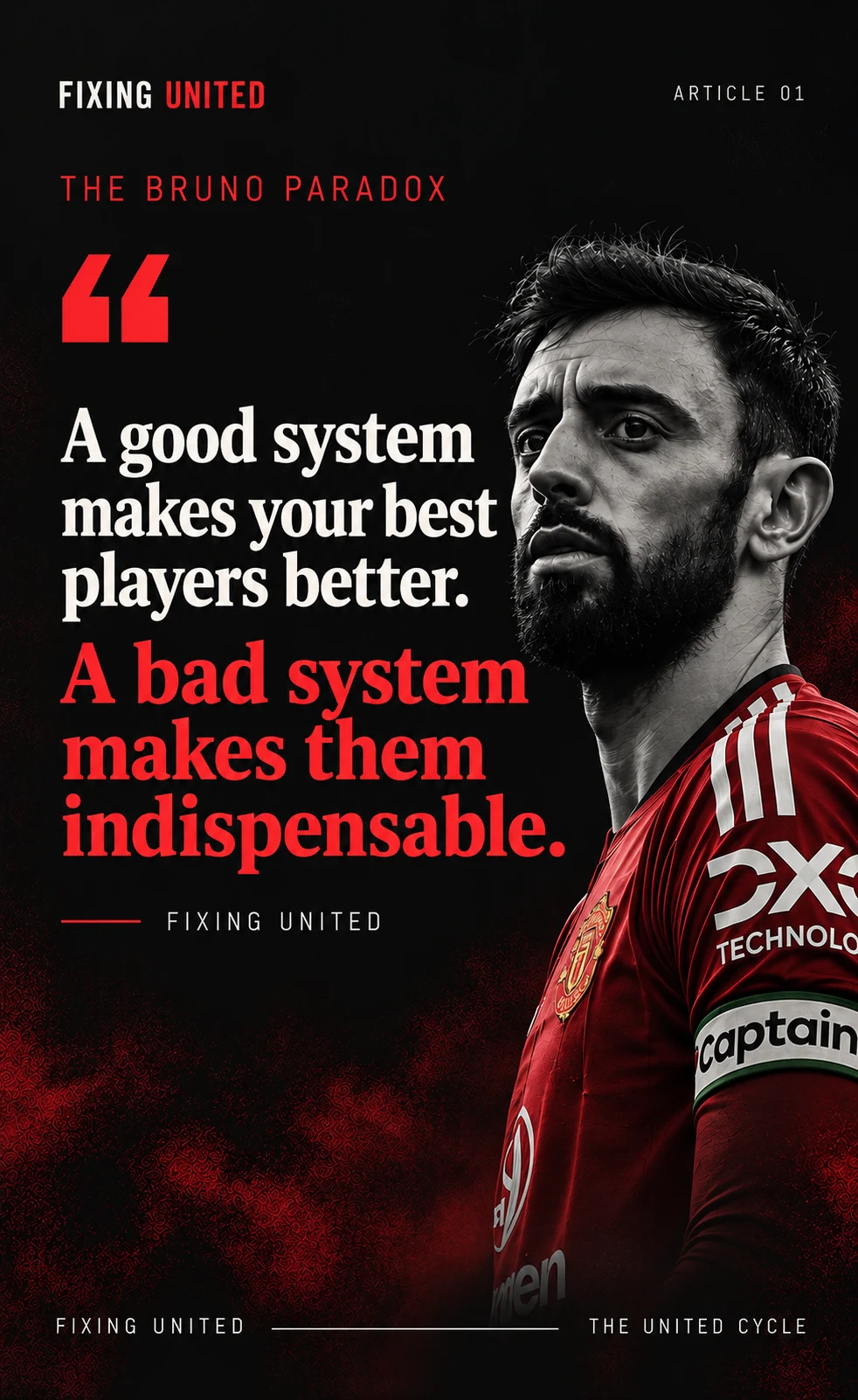
A good system makes your best players better. A bad system makes them indispensable.
But I sometimes wonder whether United's reliance on him has become too great.
When the team struggles to progress the ball, Bruno drops deeper to receive it. When the attacking movement becomes predictable, he tries a difficult pass. When nobody is creating an opening, he often takes responsibility for making something happen.
This can lead to criticism of his decision-making, particularly when ambitious passes don't come off. And sometimes that criticism is justified. Bruno can force the play, and not every difficult pass is the right decision.
But perhaps we should also ask why he so often feels the need to attempt them.
In a well-organised attacking team, coordinated movement creates passing options. Players know when to run behind, when to come short and when to occupy defenders. The system helps create the situation, and the talented player provides the final piece.
At United, it often feels as though Bruno is being asked to create both the situation and the solution.
That isn't a criticism of Bruno. It's a criticism of how dependent the team has become on his individual creativity.
The best teams need great players, but they also have attacking structures that allow those players to be great without having to solve every problem themselves.
United have repeatedly struggled to achieve that balance.
And the problem extends well beyond one player.
The cost of changing direction
There is another consequence of constantly changing football strategies, and it's one that doesn't always show up immediately on the pitch.
Money.
United have spent enormous sums on transfers and wages over the past decade, but the financial problem isn't simply that individual players have cost too much.
It's that poor decisions can limit what the club is able to do next.
A transfer fee is not just a number that disappears from the accounts when the player arrives. It creates a financial commitment that can last for years, alongside wages, bonuses and other contractual obligations.
If the player performs well and fits the team's long-term plans, that investment can make sense.
But if he struggles, loses his place or becomes unsuitable for a new manager's system, the club may find itself paying for a player it no longer particularly wants. Selling him can be difficult, especially when his wages are higher than other clubs are willing to offer.
United's 2026 annual report illustrates the scale of these commitments. The club reported £211.8 million in amortisation, primarily relating to player registrations, and approximately £302 million in employee benefit expenses for the financial year ending June 30, 2026.
Those figures require some care. Amortisation is an accounting expense, not the amount United spent on transfers that year, and employee expenses include more than the men's first-team players. They do not tell us how much money was wasted.
What they do show is how much of the club's financial structure is tied to decisions made over several previous seasons.
The same annual report recorded £452.3 million in unamortised player-registration costs at the end of June 2026. That represents significant accounting commitments associated with players already acquired, before considering later transfers.
And this is where poor recruitment can become a self-reinforcing problem.
Players who don't fit the tactical plan contribute to inconsistent performances. Poor performances create pressure on the manager. A managerial change can bring a different playing style and different recruitment priorities, but the club is still carrying the financial consequences of previous decisions.
The next rebuild therefore begins with less freedom than the last one.
That doesn't mean United's finances alone explain the team's problems. The Glazers' ownership, debt, infrastructure investment and INEOS's decisions deserve their own detailed examination, and I intend to come back to them.
But there is an obvious connection between football strategy and financial flexibility.
If you don't know what kind of team you're building, it's remarkably easy to spend a lot of money on players who don't belong in the same team.
Then you spend more trying to fix it.
And if the manager changes, you may get the opportunity to do the whole thing again.
At least we're consistent at something.
What are we actually trying to build?
I don't think United need to copy Manchester City, Arsenal or Liverpool.
There isn't one correct way to play football, and I don't believe the club should abandon everything associated with its history. United should be exciting, aggressive and capable of attacking opponents with speed. Those qualities are part of what makes the club special.
But excitement isn't a complete tactical identity, and tradition doesn't tell you how to defend a counterattack.
A modern elite team needs clear principles for what happens in different situations. How does it build attacks against a high press? How does it create chances against a low block? Where does it want to win the ball? How does it protect itself when possession is lost?
And, crucially, what qualities must its players possess to make those principles work?
The answers don't need to produce a rigid system. In fact, the best teams are adaptable. But the underlying principles should be consistent enough that recruitment, coaching and player development are all working towards the same goal.
That's what I think United have been missing.
Not necessarily a good manager. Not necessarily talented players. Not even money.
What has been missing is a sufficiently coherent connection between the football the club wants to play, the players it recruits and the way those players are coached.
It's tempting to look at the current situation and conclude that Carrick isn't good enough. Perhaps he isn't. His tactical decisions deserve scrutiny, and there is no reason to excuse performances simply because the club has deeper problems.
It's equally tempting to look back at Amorim and argue that United should have given him more time. There may be truth in that, too, although his record and the limitations of his system cannot simply be ignored.
But I think both arguments risk missing something important.
If United hired Amorim because they believed in a particular football philosophy, what was the long-term plan for building a squad around it? And if the club then decided Carrick was the right person to take United forward, what exactly was the footballing direction he was being appointed to deliver?
Was the intention to build on the counter-attacking approach that had produced such excellent results? Or was Carrick expected to transform the team into one capable of controlling possession and pressing high?
Those are different challenges, and they require different decisions.
If the club's expectations changed, did the recruitment strategy change with them? Were the players available suited to the new approach? And was there a clear understanding of how the transition would work?
These aren't questions that can be answered simply by pointing to a formation or a summer transfer window.
They go to the heart of how the football club is run.
I don't know whether Carrick will still be Manchester United manager in six months. Given how quickly things have deteriorated, I wouldn't pretend to know whether he'll still be in charge in six weeks.
But I am increasingly convinced that replacing him, on its own, would not fix what we're watching.
A new manager might improve the defensive organisation. He might make better use of the attacking players, simplify the tactics or find a more effective balance in midfield. United could start winning again, just as they did when Carrick replaced Amorim.
And we would all enjoy it. Of course we would.
The danger is mistaking that improvement for proof that the underlying problems have disappeared.
Because the same questions would remain. Can United control matches against organised opponents? Can the defensive line support the pressing approach? Can the midfield connect the team without leaving enormous spaces behind it? Can the attack create chances through repeatable patterns rather than constantly relying on Bruno to produce something special?
Most importantly, is the club building a squad that can answer those questions consistently, regardless of who happens to be standing on the touchline?
That's what I want Fixing United to explore.
Over the coming articles, I'll look more closely at United's tactical identity, defensive structure, attacking dependence on Bruno, recruitment decisions and financial commitments. I'll use match analysis and data wherever possible, and I expect some of my own assumptions to be challenged along the way.
Because there's a difference between having a strong opinion about what's wrong and actually understanding why it's wrong.
And after years of watching United repeat the same mistakes, I'd quite like us to understand the problem before we spend another fortune trying to solve it.
The more I look at this team, the more I think its weaknesses are connected.
Bruno's enormous creative responsibility isn't just a Bruno problem. A midfield that gets exposed isn't necessarily just a midfield problem. A defence that struggles to hold a high line isn't simply a question of which centre-back is too slow.
And a manager struggling to get consistent performances from an unbalanced squad isn't necessarily the only person responsible for that imbalance.
United need better performances, better coaching and better decisions. They may also need different players, and perhaps eventually a different manager.
But above all, they need a clear answer to a question that should have been settled a long time ago.
Until the club can answer that, and make its decisions consistently around the answer, I suspect we'll keep finding ourselves in the same place.
A new manager. A few encouraging results. Renewed optimism. Familiar problems.
Then the inevitable debate about who should replace him.
The United Cycle.
Again.
Fixing United is an ongoing series exploring the tactical, structural and financial decisions behind Manchester United's struggle to become a genuine title contender again. The aim isn't to defend a manager or blame a particular player. It's to understand what isn't working, why it isn't working and what the club should do about it.
Next: United Can't Control Games. Why one of the Premier League's most dangerous counter-attacking teams struggles when the opposition gives it the ball.
Mikko Seppä is a football coach and podcast analyst writing independently about Manchester United. Methodology →
- 01Read now
The United Cycle
- 02Next week
United Can't Control Games
- 03Soon
The Defence Is Holding United Back
- 04Soon
The Bruno Paradox
- 05Soon
Where Did All the Money Go?
- 06Soon
So How Do We Actually Fix United?
Discussion
0 comments- Loading discussion…